
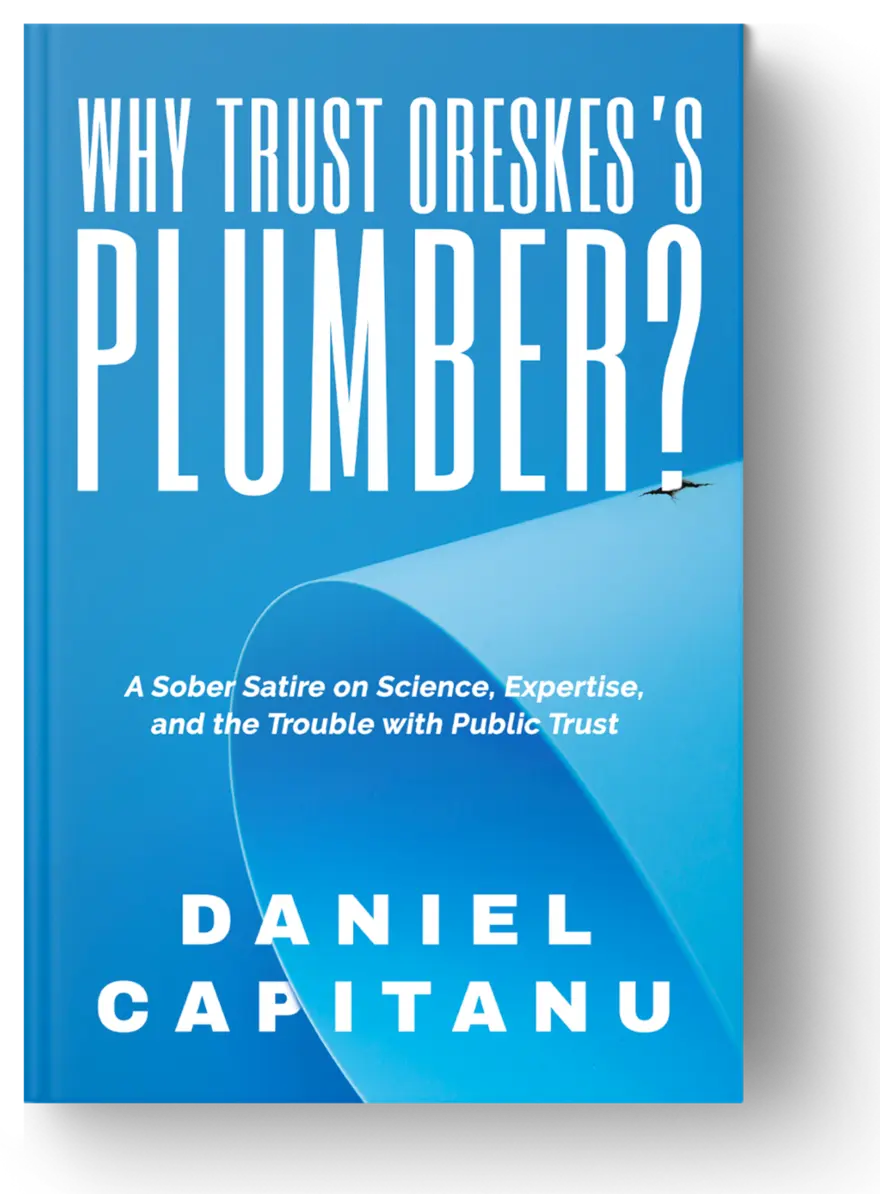
Featured title
Why Trust Oreskes’s Plumber?
A Sober Satire on Science, Expertise, and the Trouble with Public Trust
A book about what we ask of expertise before we decide to trust it.
Science deserves neither automatic suspicion nor automatic immunity from inspection. This book asks what informed trust requires when expertise, institutions, methods, values, consensus, and public policy become entangled, especially when scientific judgment enters urgent chains of public decision-making.
Audiobook
Listen to the audiobook trailer.
The audiobook edition brings Why Trust Oreskes’s Plumber? into a listening format designed for sustained attention to its argument, tone, and satire.
Official audiobook trailer
Retailer links and audiobook publication details will be published here when available.
About the book
Where reassurance becomes a question.
Taking its title from Naomi Oreskes’s familiar plumber analogy, Why Trust Oreskes’s Plumber? follows the analogy beyond the point where reassurance usually ends. What would we expect from a plumber if the diagnosis were contested, the tools disputed, the inspection rules partly controlled by the profession itself, or the consequences of error carried by people outside the trade?
Through sober satire, historical cases, philosophical distinctions, and contemporary disputes, Daniel Capitanu examines how scientific claims acquire authority and how that authority should be interpreted by citizens who cannot personally reproduce every expert judgment they are asked to trust.
Trust is unavoidable. Unconditional trust is not.
Modern societies depend on expertise. No individual can personally verify the engineering of every bridge, the evidence behind every medical recommendation, the assumptions built into every scientific model, or the institutional processes behind every expert consensus.
The book asks what makes a claim of expertise reasonably trustworthy to someone who is not an expert in the relevant field. It examines consensus, peer review, methodological rules, replication, professional gatekeeping, whistleblowing, the movement from scientific judgment to public policy, and the treatment of disputed or excluded lines of inquiry.
It does not argue that ordinary citizens should replace specialists, nor that expertise can be reduced to common sense. It asks instead whether clarity about diagnosis, transparency about assumptions, openness to inspection, proportionate confidence, accountability for error, and the possibility of a second opinion can illuminate the more difficult problem of public trust in science.
The plumber remains a recurring companion because the comparison keeps one question in view: when we are told to trust expertise, what exactly are we being asked to trust: the evidence, the method, the institution, the consensus, the jurisdiction, or the people empowered to decide which questions may be asked?
Science, authority, and urgency
When expertise meets urgency.
COVID-19 offered an immediate historical demonstration of a problem that reaches far beyond the pandemic. What happens to scientific expertise when it is drawn into the vortex of a global crisis, political pressure for rapid action, institutional responsibility, private interests, technological infrastructures, and decisions that cannot wait for scientific uncertainty to disappear?
Under such conditions, the familiar appeal to “trust the science” becomes less straightforward than it sounds. Scientific evidence, expert interpretation, institutional judgment, private involvement, political choice, and the authority to turn a recommendation into an obligation are connected, but they are not the same thing.
The difficulty deepens when events move faster than ordinary mechanisms of scrutiny. Governments may have to act before evidence is complete; scientists may be asked for answers while knowledge is still changing; companies may provide essential technologies, data, or expertise while having interests of their own. Institutions must judge under pressure, while civil society may have too little time, information, or distance to examine decisions of enormous consequence.
The question is not whether science should inform public action. It must. The harder question is what happens to trust, accountability, civil liberties, proportionality, dissent, and the possibility of a second opinion when scientific expertise enters a chain of authority operating under extreme pressure.
COVID-19 made this problem visible. It did not exhaust it. Artificial intelligence, biotechnology, biohacking, technological surveillance, and future global crises may compress the distance between scientific possibility and public consequence even further, as consequential decisions arrive faster than society can adequately examine them.
The future at stake in this book is not approaching from a distance. In important respects, it has already begun.
Key questions
Questions the book keeps open for inspection.
- What makes expert judgment worthy of trust when the non-expert cannot independently reproduce it?
- How should consensus function: as evidence, as a practical guide, as a social signal, or as something else?
- What is the difference between a scientific conclusion and a rule about which kinds of explanations are admissible as scientific?
- How do peer review, replication, institutional incentives, and professional gatekeeping strengthen or sometimes complicate public confidence?
- What changes when scientific advice moves from the laboratory or journal into policy, law, public health, education, or other forms of governance?
- What happens to scientific judgment when evidence is still evolving but governments cannot postpone decisions?
- How can citizens distinguish scientific evidence from expert interpretation, institutional judgment, private interest, and political authority when all operate inside the same urgent chain of action?
- What becomes of scrutiny, dissent, and second opinions when artificial intelligence, biotechnology, and future crises make consequential decisions faster than civil society can adequately examine them?
- Can informed trust remain genuinely pro-science while still preserving inspection, dissent, second opinions, and intellectual transparency?
Editorial transparency
Human–AI Collaboration
The book includes a formal disclosure of material artificial-intelligence involvement. A fuller public account explains the collaboration and the intellectual provenance of the work.
Read the AI disclosureDaniel Capitanu
Daniel Capitanu is the author of Why Trust Oreskes’s Plumber? The book brings together his interest in science, epistemology, institutions, expertise, and public trust.
About Daniel CapitanuLes Éditions du Rasoir
Published by an independent house focused on serious non-fiction, intellectual inquiry, and difficult questions that benefit from careful distinctions rather than easy slogans.
About the publisher